
Buying in San Francisco’s Marina, Noe Valley, or Glen Park often means jumbo-level prices and serious monthly payments. If you are comparing a temporary buydown with an adjustable-rate mortgage, you are already thinking like a strategist. The right choice can improve cash flow now while keeping long-term risk in check. This guide breaks down how each option works, what to ask lenders, and how to choose based on your timeline and comfort with risk. Let’s dive in.
The basics: buydowns vs ARMs
Temporary buydown, explained
A temporary buydown lowers your interest rate for the first years of the loan, then returns to the original note rate. Common structures include a 2-1 buydown (minus 2% in year 1, minus 1% in year 2) and a 3-2-1 buydown (minus 3% in year 1, minus 2% in year 2, minus 1% in year 3). The buydown can be funded by the seller, builder, or you. Funds typically sit in an escrow account and are applied by the servicer to reduce your payment.
The payment reduction is temporary. After the buydown period ends, your payment reflects the full note rate for the rest of the term. Principal amortization usually follows the note rate, not the temporary rate, unless your lender re-amortizes. Always request the amortization schedule and buydown escrow instructions.
ARM, explained
An adjustable-rate mortgage provides a lower initial rate that stays fixed for a set period, then adjusts based on an index plus a margin. Typical options are 5/1, 7/1, and 10/1 ARMs. In today’s market, the index is most often SOFR, and the lender adds a stated margin. Caps control how much the rate can change, often shown as initial/periodic/lifetime, such as 2/2/5.
An ARM can produce lower starting payments than a comparable fixed loan, but your rate can rise once adjustments begin. Ask your lender how you will be qualified, the exact index and margin, and what a worst-case payment would look like under the cap structure.
Why it matters in SF’s jumbo market
Marina, Noe Valley, and Glen Park frequently command prices that exceed conforming loan limits, placing many buyers in jumbo programs. Jumbos can require larger down payments, stronger reserves, and stricter documentation. Pricing varies by lender and can shift with the market, so quotes often differ day to day.
Seller-paid buydowns can be useful in competitive offers, helping sellers keep the contract price while giving you short-term payment relief. Be mindful that jumbo programs may cap seller concessions and treat buydown funds within those limits.
Cash flow and risk at a glance
- Buydown: temporary payment relief for 2–3 years, then your payment reverts to the full note rate. Predictable after the buydown period, with low interest-rate risk later.
- ARM: lower initial note rate for 5–10 years, then periodic adjustments. Greater future payment uncertainty but potentially deeper savings during the fixed window.
- Qualification: lenders vary. Some qualify buydowns at the note rate, others at the reduced payment. For ARMs, some qualify at the initial rate, others at the fully indexed rate. This impacts how much you can borrow.
Which fits your timeline?
Short hold, under 3 years
If you expect to sell, relocate, or refinance within three years, a seller-paid 2-1 or 3-2-1 buydown can maximize early cash flow. A 5/1 ARM can also work if the fixed period covers your hold. Confirm how the lender qualifies you and whether concession caps allow the seller to fund the buydown.
Medium hold, 3–7 years
A 5/1 or 7/1 ARM often offers lower payments for longer than a temporary buydown. If you plan to move or refinance before adjustments, the ARM’s fixed window can be attractive. If a buydown is available, compare cumulative costs over your planned hold period.
Long hold, 7–10+ years
If you plan to stay, predictability becomes valuable. A long-term fixed approach or a permanent rate buydown with discount points may align better than a temporary buydown or an ARM that adjusts late in your hold period.
Example scenario in the Marina (illustrative)
Consider a $1,500,000 purchase with 20% down and a $1,200,000 jumbo loan. Two sample paths:
- Fixed with a 3-2-1 buydown: note rate at 6.75%, with year 1 at note minus 3%, year 2 at minus 2%, year 3 at minus 1%, then the full note rate after year 3.
- 7/1 ARM: initial rate at 5.75% for seven years, then annual adjustments based on index plus margin, subject to caps.
How to compare:
- Build a 10-year payment timeline for each option showing monthly payments by year, including the buydown step-ups or the ARM’s fixed window and potential adjustments.
- Calculate total cash outlay over your expected hold: upfront costs plus monthly payments. Include buydown cost and who pays it.
- Compute the buydown break-even: cost of the buydown divided by monthly payment reduction to estimate months to recover.
- Model a worst-case ARM adjustment using the caps and a higher index to see a conservative payment path.
Numbers change with live quotes. Treat these figures as a comparison framework you can run with your lender.
How to compare like a pro
Use this checklist to structure apples-to-apples decisions:
- Get quotes for: current fixed note rate, 2-1 or 3-2-1 buydown costs, and 5/1–10/1 ARM initial rates.
- Confirm ARM details: index (SOFR), margin, caps, and any floors.
- Ask qualification rules: at reduced buydown payment or note rate; at initial ARM rate or fully indexed rate.
- Build a 10-year payment timeline and cumulative cash-flow comparison for each option.
- Include refinance sensitivity: target rate to make refinancing beneficial and estimated transaction costs.
- Verify jumbo constraints: seller concession caps, reserve requirements, PMI needs if applicable, and documentation.
Lender questions for SF jumbo buyers
If you use a buydown
- Who funds the buydown and how do seller concessions apply for this jumbo program?
- How are funds held and applied? Request sample buydown escrow instructions.
- Do you qualify me at the reduced payment or the note rate? Will secondary market rules accept that?
- Does the loan re-amortize after the buydown ends, or does the payment jump to the fully amortizing note-rate payment? Provide an amortization example.
- Does the buydown affect appraisal, PMI, or impound setup?
- How will the buydown appear on my disclosures?
If you use an ARM
- What is the initial rate and fixed period length? What is the index and current level?
- What is the margin and the cap structure, including any floors?
- How will my payment adjust after the fixed period, and can you show a typical and worst-case payment under caps?
- How do you qualify me, and do any overlays apply for jumbo?
- Is there a conversion option to a fixed rate later and what are the costs?
- How much notice will I receive before any rate change takes effect?
Offer strategy in competitive SF
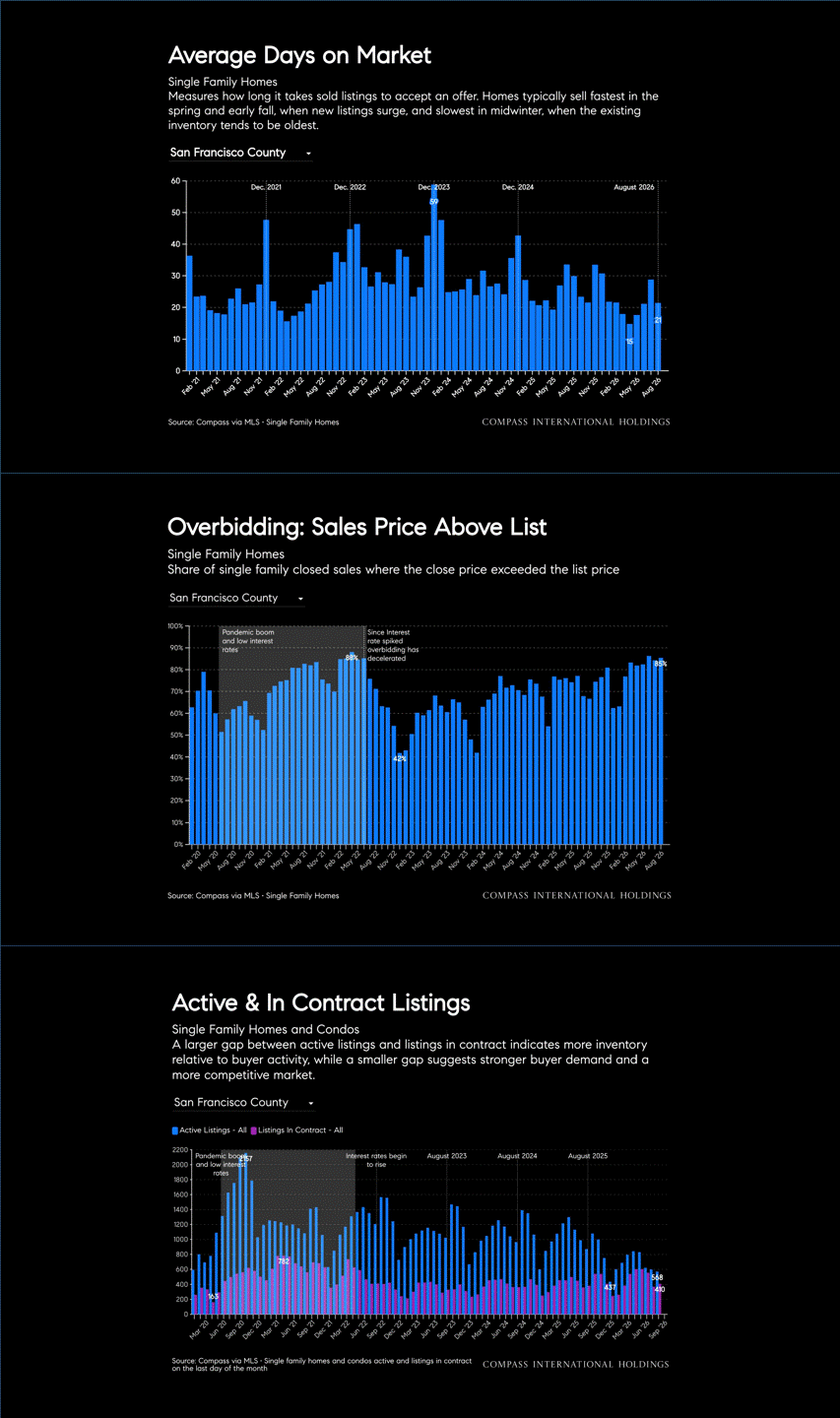
In multiple-offer situations, a seller-paid buydown can create short-term affordability without reducing the contract price. This structure may help your offer stand out while keeping the seller’s pricing goals intact. Confirm whether the concession fits within your loan program limits and whether the buydown delivers meaningful early payment relief.
Decision checklist
- Expected hold period: under 3 years, 3–7 years, or 7+ years.
- Monthly budget: where do payments feel comfortable, including possible ARM adjustments?
- Who pays for the buydown: seller, builder, or you, and are concessions capped?
- Lender qualification rules: at reduced buydown payment or note rate; at initial ARM rate or fully indexed rate.
- ARM structure details: index, margin, caps, floors, and worst-case payment.
- Reserves and documentation: confirm jumbo-specific requirements early.
Final thoughts
There is no one-size financing solution in San Francisco’s high-cost neighborhoods. A temporary buydown can be powerful if you want immediate payment relief and plan a shorter hold, especially if the seller funds it. An ARM can deliver a longer low-rate window if your hold period fits the fixed term and you accept future adjustment risk. The best choice aligns your timeline, risk tolerance, and cash-flow goals with jumbo program rules.
If you would like a tailored comparison for a home in the Marina, Noe Valley, or Glen Park, connect with Brandi Mayo for a clear, data-driven plan.
FAQs
What is a temporary buydown and how does it work on jumbo loans?
- It is an upfront-funded subsidy that temporarily reduces your interest rate and payments for 2–3 years, after which the loan payment returns to the note rate; jumbo programs may count buydown funds toward seller concession limits.
Will an ARM save more than a buydown for San Francisco buyers?
- Often yes in the initial fixed period, since ARMs usually start with a lower note rate, but they carry future adjustment risk that a temporary buydown does not.
Should I ask for a seller-paid buydown or a price reduction?
- If you need lower payments now and expect a shorter hold, a seller-paid buydown can be attractive; for longer holds, reducing price or buying permanent points may reduce total interest more.
How do lenders qualify me for buydowns and ARMs on jumbos?
- Policies vary; buydowns may be qualified at the note rate or reduced payment, while ARMs may be qualified at the initial or fully indexed rate, which affects your approved loan amount.
What happens if rates rise before my ARM adjusts?
- Your rate and payment can increase at the first adjustment, limited by the cap structure; request a worst-case payment example to see the maximum potential change.
Who typically pays for temporary buydowns in SF deals?
- Sellers, builders, or buyers can fund them; in competitive markets, buyers may request seller-funded buydowns, subject to concession caps in the loan program.